Search

because your story deserves to be told.

Tag

publishing

Integrated Feedback Analysis: How to Turn Feedback Into Clear, Actionable Direction

Brandie Richardson

To learn more, visit us at https://www.ndppublications.com/analysis.html

For all writers, feedback is essential. For many, it is also overwhelming.

You send your manuscript out to beta readers, maybe an editor, perhaps a proofreader or two. What comes back is a flood of notes, suggestions, reactions, and revisions. Some are insightful. Some contradict each other. Some raise concerns you hadn’t considered, while others leave you wondering which direction to trust.

At a certain point, more feedback doesn’t create clarity. It creates noise and the challenge migrates from improving your manuscript to understanding what the feedback actually means when viewed as a whole.

This is where many writers get stuck.

Patterns are difficult to identify when comments are scattered across documents, emails, and tracked changes. One reader flags pacing issues, another focuses on character consistency, while a third praises the very elements someone else questioned. Without a structured way to evaluate that input, authors are often left making decisions based on instinct rather than insight.

But even when feedback is consistent, a different problem often emerges.

Not all feedback is easy to interpret.

Terms like “pacing,” “voice,” “character agency,” or “narrative tension” are frequently used, but not always clearly explained. Authors may recognize that something needs to change without fully understanding what that change should look like on the page. Others receive strong feedback but struggle to translate it into actionable revisions.

In both cases, the result is the same: uncertainty.

Feedback only helps if you know what to do with it.

And in an industry where costly services are often positioned as the next step, confusion can quickly turn into unnecessary spending.

There is a more effective approach.


Introducing Integrated Feedback Analysis

Integrated Feedback Analysis is designed to bring order to the chaos of manuscript feedback.

Instead of asking you to interpret conflicting opinions on your own, this service consolidates input from multiple sources into a single, structured report. Every comment is evaluated in context, allowing patterns, consistencies, and outliers to emerge clearly.

Just as importantly, it translates feedback into practical direction.

Rather than leaving authors to decode industry terminology or vague suggestions, the analysis clarifies what the feedback actually means and how it applies to your manuscript. It distinguishes between isolated opinions and recurring issues, highlights where readers consistently respond in the same way, and identifies where feedback may be subjective or contradictory.

The result is not more information. It is clear, usable direction.


Why This Matters

Many authors assume the next step after receiving feedback is to invest in additional services. In reality, the more critical step is understanding what you already have.

Without that clarity, it is easy to over-edit, chase conflicting suggestions, or invest in services that address symptoms rather than root issues. Even strong, consistent feedback loses value if you cannot confidently apply it.

Integrated Feedback Analysis bridges that gap.

It gives you a complete, objective view of your manuscript and translates that insight into something you can act on.

It is not about replacing editors or beta readers. It is about making their input more useful.


Flexible and Accessible

This service is available to any author. You do not need to have purchased other services from Nom de Plume Publications to take advantage of it.

For authors who have already worked within the Nom de Plume ecosystem, discounted pricing may be available, making it an efficient next step in the revision process.


Clarity Before the Next Step

In a publishing landscape where authors are often encouraged to spend first and evaluate later, taking the time to understand your feedback is one of the most valuable decisions you can make.

Integrated Feedback Analysis gives you that clarity.

Instead of guessing which direction to take, you move forward with a clear understanding of your manuscript, your feedback, and exactly how to use it.

Image created using AI

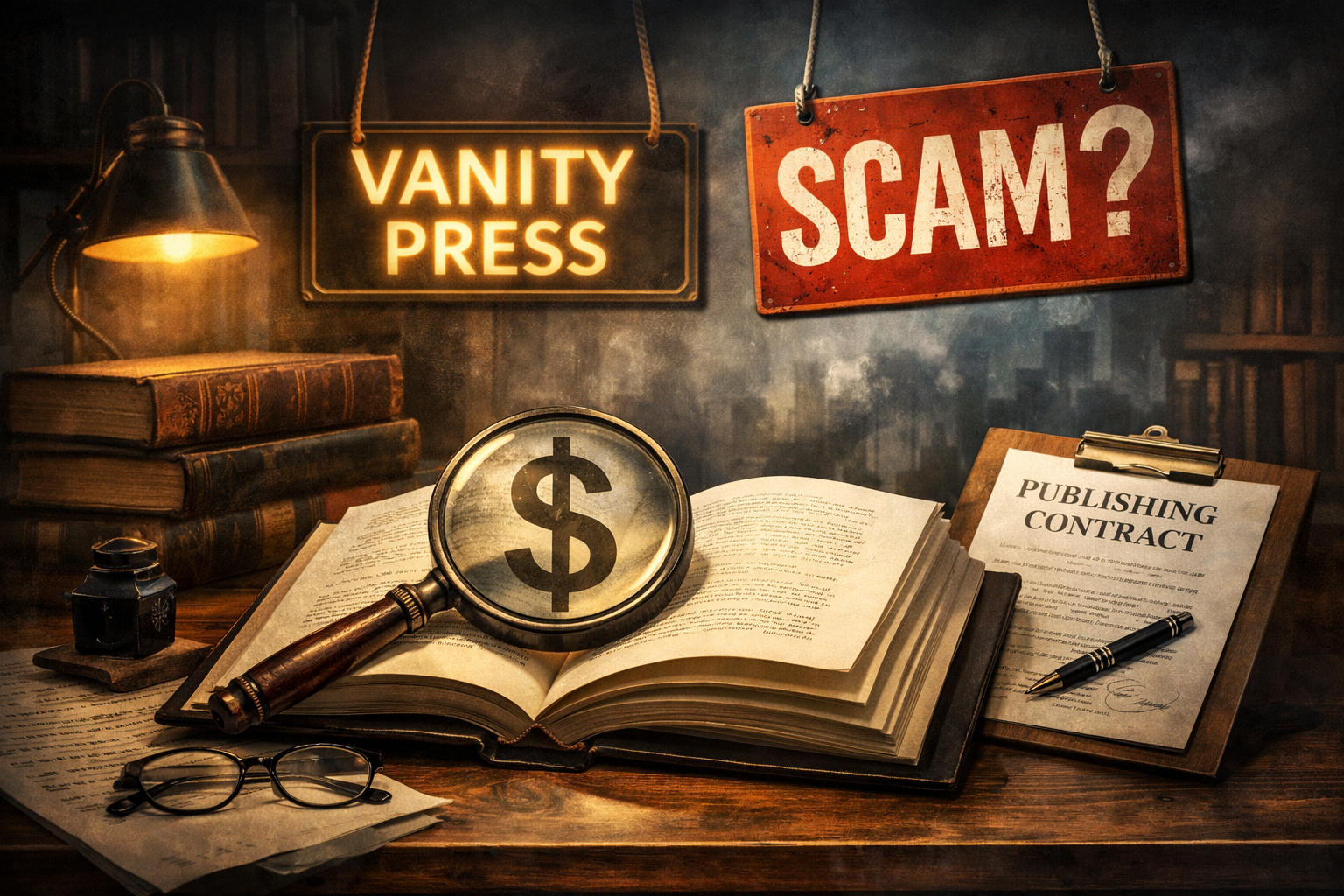
Are Vanity Presses Always a Scam? What Authors Need to Know Before Signing on the Dotted Line.

Image generated using AI

Brandie Richardson

As more authors explore self-publishing, one question comes up again and again: are vanity presses* always a scam?

(*I’m going to stop here to clarify that Nom De Plume Publications is not a vanity press. We work with and support self-publishing authors and writers exclusively.)

The short answer is no. Not every vanity press operates deceptively.But that answer comes with a very large asterisk.

Vanity presses, sometimes called subsidy publishers, operate on a simple model: the author pays upfront for publishing services. In theory, this can be a legitimate business arrangement. Authors may choose to pay for editing, cover design, formatting, or marketing rather than navigate those steps independently.

The problem is not the model itself. The problem is how often that model is used as a disguise.

In practice, many companies operating under the vanity or hybrid publishing label blur the line between service provider and traditional publisher, presenting themselves as partners in success while quietly shifting all financial risk onto the author. When those companies rely on misleading promises, inflated pricing, or restrictive contracts, the relationship moves from transactional to predatory.

Understanding where that line sits is essential for any author considering their options.


What a Vanity Press Is and Where It Goes Wrong

A vanity press publishes your work in exchange for payment. They typically bundle services such as editing, cover design, distribution, and marketing into packages that can range from hundreds to thousands of dollars.

On its own, paying for services is not inherently unethical. Many independent professionals offer those same services à la carte, often at competitive rates. The issue arises when companies present those paid services as something more than they are.

Predatory presses frequently imply that payment secures not just production, but opportunity. They suggest access to bookstores, media coverage, or meaningful sales channels without having the infrastructure to deliver those outcomes. In some cases, they charge premium prices for services that are minimal, generic, or never fully executed.

More concerning are contracts that quietly transfer or restrict author rights, limiting future publishing options even if the company fails to perform.


How These Companies Operate in the Real World

Industry reporting, watchdog organizations, and author advocacy groups have documented consistent patterns across vanity press scams.

One of the most common tactics is aggressive outreach paired with flattery. Authors may receive unsolicited emails or calls praising their manuscript and urging quick action to “secure” an opportunity. The tone is often urgent, designed to move the author toward payment before they have time to research or reflect.

Terminology is another frequent point of confusion. Some companies adopt labels like “independent publisher” or “hybrid imprint,” creating the impression of a traditional publishing relationship while still requiring substantial upfront fees. For newer authors especially, the distinction is not always clear.

Contracts can present the most lasting damage. Agreements may grant exclusive rights across multiple formats for extended periods, sometimes with vague or minimal obligations on the publisher’s part. Authors may find themselves unable to republish or reclaim their work, even when sales are nonexistent.


Documented Patterns and Author Experiences

These concerns are not hypothetical. They are reflected in repeated, real-world experiences shared across industry channels and author communities.

Writers have reported being approached with supposed representation deals that required upfront fees, only for the opportunity to disappear once payment was made. Others have invested thousands of dollars into publishing packages that delivered only basic formatting or templated cover designs, with no meaningful marketing or distribution to follow.

There are also cases where authors unknowingly signed contracts that locked their rights for years, preventing them from pursuing other publishing avenues. In online communities such as Reddit’s self-publishing forums, authors frequently compare notes on companies that use misleading branding, including names that suggest affiliation with established platforms when no such connection exists.

Another recurring complaint involves persistent, unsolicited contact. Some authors describe ongoing calls or emails from publishing services promising royalties and exposure that never materialize in any measurable way.

Taken together, these accounts reveal a consistent pattern: the business model often depends less on selling books and more on selling services to authors.


Why Even Smart Authors Get Caught

It is easy to assume that only inexperienced writers fall into these traps, but that is not always the case.

Flattery is a powerful entry point. When someone presents your work as exceptional and time-sensitive, it can override the instinct to pause and verify. Urgency compounds that effect, encouraging quick decisions in a space that requires careful scrutiny.

Credibility is often manufactured through imitation. Companies may mirror the language, branding, or structure of legitimate publishers, making it difficult to distinguish between a service provider and a traditional publishing house at a glance.

There is also a broader issue of information imbalance. While reliable resources exist, they are often buried beneath paid advertising and promotional content. Authors who are actively seeking opportunities may encounter persuasive marketing long before they encounter cautionary guidance.


Recognizing the Warning Signs

The most reliable safeguard is not a single rule, but a pattern of awareness.

Any request for significant upfront payment tied to a “publishing deal” should prompt closer examination. Clear, professional service providers charge for defined work, not for access to vague opportunities.

Contracts deserve particular attention. Language that grants exclusive, long-term rights without equally clear performance expectations is a strong signal to pause and seek clarification or legal advice.

Company identity should be easy to verify. A legitimate business will have a consistent name, a traceable presence, and transparent affiliations. If a company’s branding shifts or leans heavily on the reputation of larger platforms without confirmation, that is worth investigating.

Finally, promises that sound effortless often are. Fast publication, guaranteed success, or broad distribution without a clear, verifiable process are not industry norms.


Staying in Control of Your Publishing Path

Authors have more tools and options than ever before, which makes due diligence both possible and essential.

Research should extend beyond a company’s own website. Independent reviews, watchdog reports, and author forums provide a more complete picture of how a company operates in practice. Speaking directly with authors who have used the service, especially those not featured as testimonials, can offer valuable perspective.

It is also worth comparing bundled publishing packages to hiring independent professionals. In many cases, authors can retain full control of their rights while assembling a team of editors, designers, and marketers at a comparable or lower cost.

Most importantly, no legitimate opportunity requires immediate commitment. Time spent reviewing, questioning, and verifying is never wasted.


Conclusion

Vanity presses are not inherently scams, but they exist in a space where the line between service and exploitation is frequently crossed.

Self-publishing has opened the door for authors to bring their work into the world on their own terms. That freedom is real, but it comes with the responsibility to evaluate who you trust with your work, your money, and your rights. The safest approach is not fear, but clarity. Ask questions, read carefully, and remember that in publishing, as in most industries, the best partnerships are transparent about what they offer and what they do not

Lights, Camera… Scam! How Fake Film & Media Deals Target Authors

Brandie Richardson

Every writer dreams of seeing their stories adapted for the big screen. With hits like HBO’s Heated Rivalry, it’s easy to imagine your book becoming the next breakout success story but unfortunately, that dream is exactly what scammers exploit. From unsolicited emails claiming Hollywood interest to fake production companies, these scams promise fame and fortune — but often end with empty pockets and stolen hope.

Image AI Generated

How the Scam Works

Scammers impersonate film producers, agents, or studio executives. They claim interest in:

  • Optioning a book for adaptation
  • Producing a short film or web series
  • Selling rights for TV or streaming platforms

Then they request upfront fees for things like:

  • Script consultation or conversion fees
  • “Legal processing” for option agreements
  • Promotional packages or festival submissions

Once payment is made, the scammer often vanishes, leaving no legitimate contact or deal.

Documented Cases

1. Hollywood Impersonation Scams
Authors Guild and Writer Beware have reported multiple cases where scammers used emails or phone calls to impersonate agents or producers associated with recognized studios. Authors are told they must pay fees to secure “contracts” or “option rights” — fees that can range from hundreds to tens of thousands of dollars. (authorsguild.org)

2. Community Reports
Reddit’s r/selfpublish has numerous firsthand accounts:

  • One author received a detailed email claiming their book was selected for a feature film. The supposed agent asked for $500 to process contracts. The author confirmed the production company did not exist. (reddit.com)
  • Another reported receiving a call from a “Netflix producer” who wanted to adapt their self‑published work. After a $2,000 “legal fee,” communication ceased. (reddit.com)

3. Pattern Consistency
Across all reports, scammers:

  • Use urgent language (“You must pay within 48 hours to secure rights”)
  • Provide official-looking documents, often with fake logos and letterhead
  • Reference real Hollywood companies, but with slightly altered names

Why Authors Fall for It

  • Excitement: The promise of fame and big money is irresistible
  • Authority Illusion: Scammers include fake contracts, websites, and social media profiles
  • Pressure Tactics: Urgency and exclusivity make authors act without proper verification

Even experienced authors can be caught off guard because these scams are polished and professional-looking.

Red Flags to Watch

1. Unsolicited Contact
Legitimate studios and agents rarely reach out cold to unknown authors.

2. Requests for Upfront Money
No legitimate studio or agent asks you to pay for options, scripts, or rights processing.

3. Slightly Off Company Names
Scammers often use names similar to real studios, e.g., “Netflicks Productions” instead of Netflix.

4. Lack of Independent Verification
Check the company and agent through multiple sources. If no legitimate records exist, it’s a scam.

5. Urgent Payment Demands
High-pressure deadlines for payment are never part of genuine media deals.

How to Protect Yourself

  • Verify the studio or agent via official directories or LinkedIn.
  • Ask for references or prior deals; confirm independently.
  • Never pay fees to secure film rights or options.
  • Consult a publishing or entertainment attorney before signing anything.

Scammers prey on authors’ dreams of seeing their work adapted. By recognizing the red flags – unsolicited offers, fake company names, and upfront fee demands – you can protect your creative work and your wallet.

Blog at WordPress.com.

Up ↑