K. Rhodes
You can’t spend any time on social media platforms right now without encountering one of the current scourges of the industry… the endless wave of viral claims about how to “spot” AI writing. Every few weeks a new one appears: if a piece contains a certain phrase, follows a particular structure, or uses a specific punctuation mark, then supposedly you can immediately tell it was written by artificial intelligence. The claims spread quickly and confidently with very little evidence behind them.
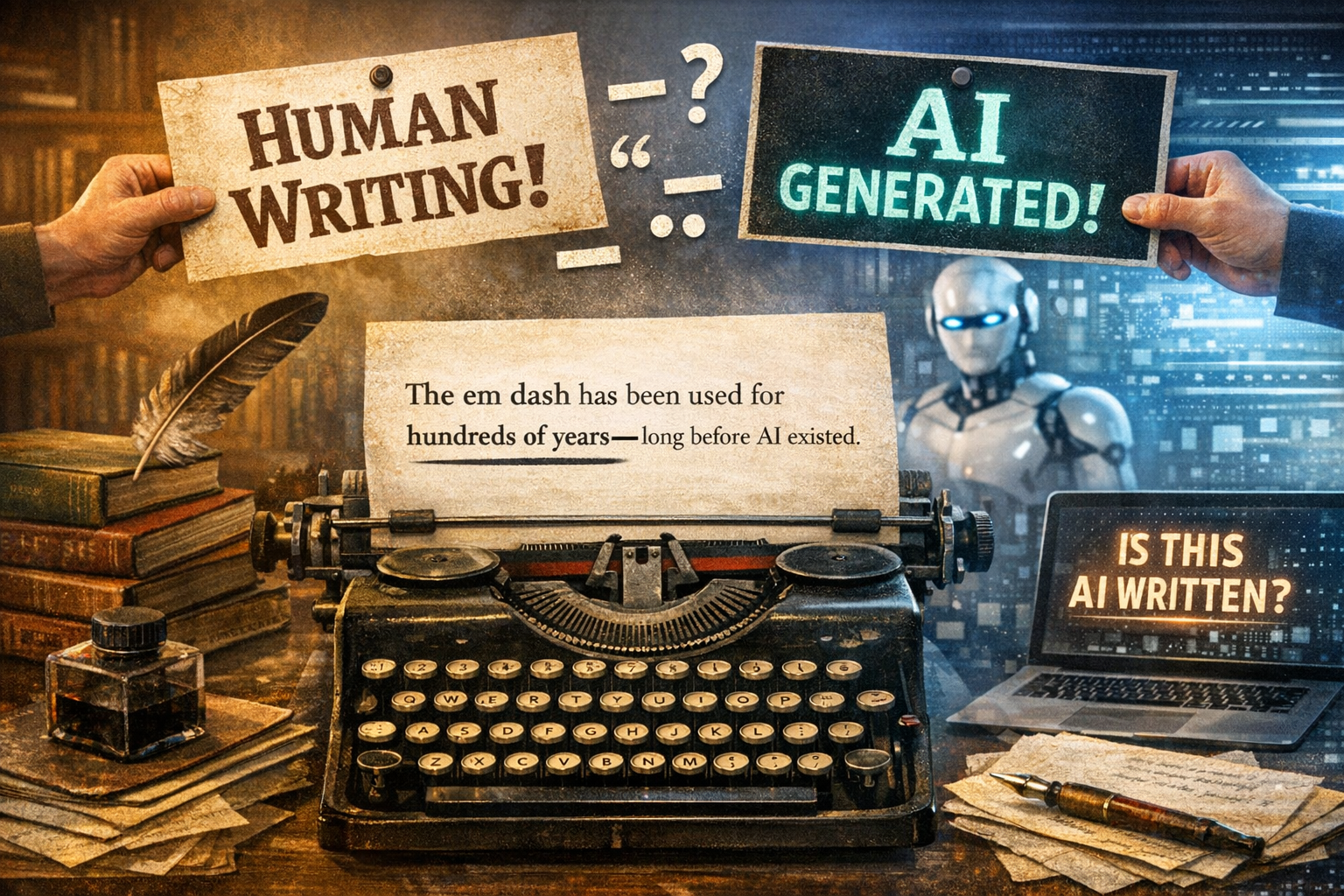
Image is AI generated
This trend is more than just irritating. It can be genuinely harmful. Writers are increasingly using these supposed “tells” as a way to publicly accuse other creators of using AI simply because their work looks different from their own. In many cases, what is being labeled suspicious is simply polished prose, professional punctuation, or a writing style that happens to be more formal than the accuser is used to.
One of the latest targets in this cycle is the em dash. According to a rampant internet rumor, if a piece of writing contains em dashes, it must have been generated by AI. Like most viral writing myths, the claim falls apart the moment you look at the actual history of the punctuation mark.
Now, personally, I hate them with the heat of a thousand suns and usually make a stylistic choice to avoid them in my creative projects but that doesn’t mean books that have them – even modern ones – are AI generated.
The em dash has been part of English punctuation for hundreds of years, long before computers, the internet, or even the typewriter. Far from being a modern invention of AI tools, the em dash has a rich history in literature and publishing, and it remains one of the most flexible punctuation marks writers have. To understand why it still appears so often today, it helps to look at where it came from and how writers have used it for generations.
An em dash is the long dash that looks like this: —. Its name comes from typography. In traditional printing, the dash was roughly the width of the capital letter “M,” which printers referred to as an “em.” From that measurement came the name em dash. It is longer than the en dash (–) and much longer than a hyphen (-).
Writers typically use the em dash to create a strong pause in a sentence, insert an aside or additional thought, or emphasize a point or interruption. For example: The door creaked open — and suddenly the house didn’t feel empty anymore. The dash creates a moment of tension that a comma or period would not quite capture.
The em dash began appearing regularly in English printed works during the eighteenth century, when advances in printing made punctuation more standardized. Early printers and editors quickly discovered how useful the dash could be. It allowed writers to represent pauses, interruptions, and shifts in thought that reflected natural speech in a way that other punctuation could not.
By the nineteenth century, the em dash had become a favorite tool among some of the most famous writers in history. Charles Dickens used dashes liberally to shape dialogue and pacing. Herman Melville used them in Moby-Dick. Jane Austen occasionally used them to indicate interrupted speech. Perhaps the most famous enthusiast of the em dash was Emily Dickinson, whose poetry relies heavily on it to control rhythm and meaning. In poems such as Because I could not stop for Death — / He kindly stopped for me —, the dash becomes part of the poem’s structure itself.
These examples illustrate something important: the em dash was already a well-established literary device long before modern technology entered the picture.
Part of the reason the em dash has endured is its flexibility. Unlike commas or semicolons, which follow strict grammatical rules, the em dash is more expressive. It allows writers to mimic the way people actually think and speak. A dash can create suspense, introduce an unexpected twist, or signal a sudden shift in thought. In many ways it functions as a storytelling tool as much as a grammatical one. That versatility is why journalists, novelists, essayists, and bloggers all continue to use it regularly.
The idea that em dashes signal AI writing is a very recent internet myth. It likely grew out of a few overlapping trends. Modern language models are trained on professionally edited writing such as books, journalism, and long-form articles. Those sources frequently use proper punctuation, including em dashes. At the same time, many people writing casually online rarely use them. Social media posts often favor shorter sentences, emojis, and simpler punctuation.
When readers suddenly encounter polished punctuation in everyday online content, it can feel unusual. Some assume that unfamiliar polish must come from AI. But this assumption misunderstands both artificial intelligence and punctuation. AI models did not invent the em dash. They learned it by analyzing centuries of human writing.
If someone claims they can detect AI writing simply by spotting an em dash, they are relying on a myth rather than evidence. Punctuation alone cannot determine whether a piece of writing was created by a human or a machine. Many human writers use em dashes frequently, while many AI-generated texts contain none at all. Professional editors, journalists, and novelists often use them deliberately to control pacing and emphasis. Under the “em dash equals AI” myth, those writers would constantly be misidentified.
The truth is far simpler: the em dash is just good writing.
Despite periodic internet debates, the em dash remains one of the most useful punctuation tools available to writers. It has survived the transition from printing presses to typewriters and then to digital word processors. Today it appears in novels, newspapers, academic papers, and online articles alike.
Long before artificial intelligence entered the conversation, the em dash was already shaping the rhythms of English prose. So the next time someone claims that an em dash proves a piece of writing was generated by AI, remember the long literary history behind that simple line and move on without engaging.
And for the love of literature, please stop making unfounded accusations that can damage reputations and cost livelihood. For those of us who have a catalog that predates AI, we’ll be able to prove our history and probably survive it, but it could easily ruin a new author who might be on the path to write the next great story.
Let’s do better. ♥
Love, Kian
Kian Rhodes is a regular contributor to the Nom de Plume Publications blog.
 nomdeplumepublications.com