Search

because your story deserves to be told.

Category

The More You Know

Integrated Feedback Analysis: How to Turn Feedback Into Clear, Actionable Direction

Brandie Richardson

To learn more, visit us at https://www.ndppublications.com/analysis.html

For all writers, feedback is essential. For many, it is also overwhelming.

You send your manuscript out to beta readers, maybe an editor, perhaps a proofreader or two. What comes back is a flood of notes, suggestions, reactions, and revisions. Some are insightful. Some contradict each other. Some raise concerns you hadn’t considered, while others leave you wondering which direction to trust.

At a certain point, more feedback doesn’t create clarity. It creates noise and the challenge migrates from improving your manuscript to understanding what the feedback actually means when viewed as a whole.

This is where many writers get stuck.

Patterns are difficult to identify when comments are scattered across documents, emails, and tracked changes. One reader flags pacing issues, another focuses on character consistency, while a third praises the very elements someone else questioned. Without a structured way to evaluate that input, authors are often left making decisions based on instinct rather than insight.

But even when feedback is consistent, a different problem often emerges.

Not all feedback is easy to interpret.

Terms like “pacing,” “voice,” “character agency,” or “narrative tension” are frequently used, but not always clearly explained. Authors may recognize that something needs to change without fully understanding what that change should look like on the page. Others receive strong feedback but struggle to translate it into actionable revisions.

In both cases, the result is the same: uncertainty.

Feedback only helps if you know what to do with it.

And in an industry where costly services are often positioned as the next step, confusion can quickly turn into unnecessary spending.

There is a more effective approach.


Introducing Integrated Feedback Analysis

Integrated Feedback Analysis is designed to bring order to the chaos of manuscript feedback.

Instead of asking you to interpret conflicting opinions on your own, this service consolidates input from multiple sources into a single, structured report. Every comment is evaluated in context, allowing patterns, consistencies, and outliers to emerge clearly.

Just as importantly, it translates feedback into practical direction.

Rather than leaving authors to decode industry terminology or vague suggestions, the analysis clarifies what the feedback actually means and how it applies to your manuscript. It distinguishes between isolated opinions and recurring issues, highlights where readers consistently respond in the same way, and identifies where feedback may be subjective or contradictory.

The result is not more information. It is clear, usable direction.


Why This Matters

Many authors assume the next step after receiving feedback is to invest in additional services. In reality, the more critical step is understanding what you already have.

Without that clarity, it is easy to over-edit, chase conflicting suggestions, or invest in services that address symptoms rather than root issues. Even strong, consistent feedback loses value if you cannot confidently apply it.

Integrated Feedback Analysis bridges that gap.

It gives you a complete, objective view of your manuscript and translates that insight into something you can act on.

It is not about replacing editors or beta readers. It is about making their input more useful.


Flexible and Accessible

This service is available to any author. You do not need to have purchased other services from Nom de Plume Publications to take advantage of it.

For authors who have already worked within the Nom de Plume ecosystem, discounted pricing may be available, making it an efficient next step in the revision process.


Clarity Before the Next Step

In a publishing landscape where authors are often encouraged to spend first and evaluate later, taking the time to understand your feedback is one of the most valuable decisions you can make.

Integrated Feedback Analysis gives you that clarity.

Instead of guessing which direction to take, you move forward with a clear understanding of your manuscript, your feedback, and exactly how to use it.

Image created using AI

LevelUP Through Us is finally here!

For more than a decade, Nom de Plume Publications llc has worked with independent authors, helping writers bring their books and ideas into the world. Over the years, one thing became clear. Many talented writers are ready to move into freelance writing, content creation, and professional publishing, but they often run into the same obstacle: being asked for links to previously published work.

LevelUP Through Us was created to help solve that problem.

The platform gives writers the opportunity to submit original work for professional editorial review and publication, helping them build a visible portfolio of bylined articles they can confidently share with editors, clients, collaborators, and readers.

When an article is published, it becomes a permanent professional link that writers can use to demonstrate their ability and strengthen their writing portfolios.

LevelUP Through Us is designed to support writers at every stage, from those building their first professional portfolio to experienced creators expanding their presence and influence.

We are incredibly excited to see the ideas, insights, stories, and expertise writers will bring to the platform.

If you’re ready to start building your publication history, we invite you to explore the platform and submit your work.

LevelUP Through Us and Start building your byline today!

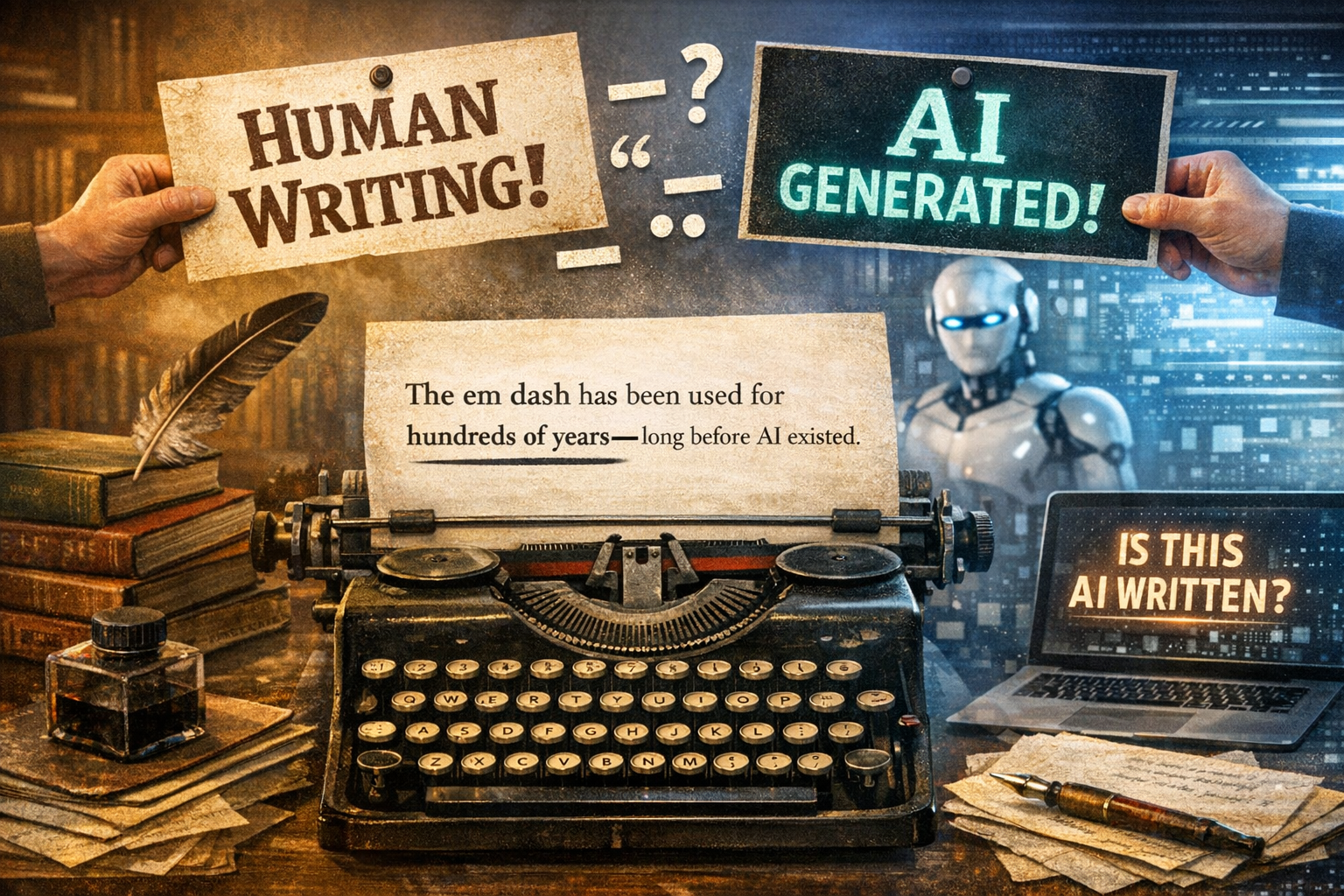
Are EM Dashes the Key to Identifying AI Content?

K. Rhodes

You can’t spend any time on social media platforms right now without encountering one of the current scourges of the industry… the endless wave of viral claims about how to “spot” AI writing. Every few weeks a new one appears: if a piece contains a certain phrase, follows a particular structure, or uses a specific punctuation mark, then supposedly you can immediately tell it was written by artificial intelligence. The claims spread quickly and confidently with very little evidence behind them.

Image is AI generated

This trend is more than just irritating. It can be genuinely harmful. Writers are increasingly using these supposed “tells” as a way to publicly accuse other creators of using AI simply because their work looks different from their own. In many cases, what is being labeled suspicious is simply polished prose, professional punctuation, or a writing style that happens to be more formal than the accuser is used to.

One of the latest targets in this cycle is the em dash. According to a rampant internet rumor, if a piece of writing contains em dashes, it must have been generated by AI. Like most viral writing myths, the claim falls apart the moment you look at the actual history of the punctuation mark.

Now, personally, I hate them with the heat of a thousand suns and usually make a stylistic choice to avoid them in my creative projects but that doesn’t mean books that have them – even modern ones – are AI generated.

The em dash has been part of English punctuation for hundreds of years, long before computers, the internet, or even the typewriter. Far from being a modern invention of AI tools, the em dash has a rich history in literature and publishing, and it remains one of the most flexible punctuation marks writers have. To understand why it still appears so often today, it helps to look at where it came from and how writers have used it for generations.

An em dash is the long dash that looks like this: —. Its name comes from typography. In traditional printing, the dash was roughly the width of the capital letter “M,” which printers referred to as an “em.” From that measurement came the name em dash. It is longer than the en dash (–) and much longer than a hyphen (-).

Writers typically use the em dash to create a strong pause in a sentence, insert an aside or additional thought, or emphasize a point or interruption. For example: The door creaked open — and suddenly the house didn’t feel empty anymore. The dash creates a moment of tension that a comma or period would not quite capture.

The em dash began appearing regularly in English printed works during the eighteenth century, when advances in printing made punctuation more standardized. Early printers and editors quickly discovered how useful the dash could be. It allowed writers to represent pauses, interruptions, and shifts in thought that reflected natural speech in a way that other punctuation could not.

By the nineteenth century, the em dash had become a favorite tool among some of the most famous writers in history. Charles Dickens used dashes liberally to shape dialogue and pacing. Herman Melville used them in Moby-Dick. Jane Austen occasionally used them to indicate interrupted speech. Perhaps the most famous enthusiast of the em dash was Emily Dickinson, whose poetry relies heavily on it to control rhythm and meaning. In poems such as Because I could not stop for Death — / He kindly stopped for me —, the dash becomes part of the poem’s structure itself.

These examples illustrate something important: the em dash was already a well-established literary device long before modern technology entered the picture.

Part of the reason the em dash has endured is its flexibility. Unlike commas or semicolons, which follow strict grammatical rules, the em dash is more expressive. It allows writers to mimic the way people actually think and speak. A dash can create suspense, introduce an unexpected twist, or signal a sudden shift in thought. In many ways it functions as a storytelling tool as much as a grammatical one. That versatility is why journalists, novelists, essayists, and bloggers all continue to use it regularly.

The idea that em dashes signal AI writing is a very recent internet myth. It likely grew out of a few overlapping trends. Modern language models are trained on professionally edited writing such as books, journalism, and long-form articles. Those sources frequently use proper punctuation, including em dashes. At the same time, many people writing casually online rarely use them. Social media posts often favor shorter sentences, emojis, and simpler punctuation.

When readers suddenly encounter polished punctuation in everyday online content, it can feel unusual. Some assume that unfamiliar polish must come from AI. But this assumption misunderstands both artificial intelligence and punctuation. AI models did not invent the em dash. They learned it by analyzing centuries of human writing.

If someone claims they can detect AI writing simply by spotting an em dash, they are relying on a myth rather than evidence. Punctuation alone cannot determine whether a piece of writing was created by a human or a machine. Many human writers use em dashes frequently, while many AI-generated texts contain none at all. Professional editors, journalists, and novelists often use them deliberately to control pacing and emphasis. Under the “em dash equals AI” myth, those writers would constantly be misidentified.

The truth is far simpler: the em dash is just good writing.

Despite periodic internet debates, the em dash remains one of the most useful punctuation tools available to writers. It has survived the transition from printing presses to typewriters and then to digital word processors. Today it appears in novels, newspapers, academic papers, and online articles alike.

Long before artificial intelligence entered the conversation, the em dash was already shaping the rhythms of English prose. So the next time someone claims that an em dash proves a piece of writing was generated by AI, remember the long literary history behind that simple line and move on without engaging.

And for the love of literature, please stop making unfounded accusations that can damage reputations and cost livelihood. For those of us who have a catalog that predates AI, we’ll be able to prove our history and probably survive it, but it could easily ruin a new author who might be on the path to write the next great story.

Let’s do better. ♥

Love, Kian

Kian Rhodes is a regular contributor to the Nom de Plume Publications blog.

How Chasing Facebook Monetization Could Be Costing You Meaningful Engagement

K. Rhodes

A note from the contributor: All of the examples I used were meme-style posts shared by three or more people except the last one, so please don’t feel called out or attacked if you also shared it. ♥ Love, Kian

I logged onto Facebook this morning and my feed was immediately filled with posts that had me shaking my head. Writers I follow for updates on their work were posting the same recycled engagement spam that floods the platform every day: “Name an actor NOT FROM the US,” “What things do Americans do that make you go… ‘Wait, that’s weird’? ,” “THE funniest movie you’ve ever seen in your whole life,” and “If you had one wish granted, what would it be?” One even had the hashtag #engagementpost.

But the post that made me close my laptop and pick up my pen came from an author page I’d noticed seemed to be nothing but recycled content shared from other accounts for several days. This one was original but read, “PLEASE like or comment! I’m trying so hard to meet my Facebook goals but my engagement is down!” That was it—no story updates, no writing insight, nothing meaningful for the audience—just a plea for reactions.


Why It Matters

There’s absolutely nothing wrong with writers exploring additional revenue streams—diversifying income is smart and necessary in today’s competitive publishing world. But many are falling into the Facebook goal-based monetization trap without realizing it. The harder they push to hit these metrics—posting constant prompts, recycled engagement bait, and pleas for reactions—the more they risk undermining the very things that actually generate income: their writing that their loyal audience is there for.

Every low-value post that followers scroll past trains the algorithm to hide future posts. That means the posts that matter most—book announcements, live readings, or exclusive insights—may never reach the people who support them where it counts… in their book sales and pages read. (#KindleUnlimited authors, I’m looking at you!)

 Creators are essentially spending hours on content that doesn’t just fail to pad their bottom line—they’re actively sabotaging their income potential without realizing it.


How the Facebook Goal-Based Monetization Program Works

Facebook’s program rewards creators who maintain over 500 followers and hit periodic engagement goals. Payouts are based on how well your content performs according to visible metrics—likes, comments, shares, and reach. Unlike Stars, where fans voluntarily tip you, this program pays because Facebook measures your performance, not because your audience chooses to support you.

The system is designed to look like a shortcut to money: clear goals, visible engagement metrics, and bonus payouts create the illusion that “more posts = more income.” But the algorithm prioritizes original, creator-driven content. Recycled prompts or generic engagement bait may briefly get reactions, but these posts are increasingly devalued by Facebook. The harder authors push to meet metrics with low-value posts, the more they risk suppressing their visibility and weakening the connection with their core audience.


Why Chasing Metrics Backfires

  1. Originality Matters: Generic, recycled posts are not rewarded the way people think. Facebook favors posts that are unique, valuable, and authentic to the creator. A meme that generates hundreds of reactions can still fail to generate monetization if other creators shared it first.
  2. Audience Fatigue: Constant low-value posts train fans to scroll past, signaling disinterest to the algorithm.
  3. Metrics Can Be Misleading: Likes, shares, and comments on generic or recycled engagement posts do not automatically count toward the Facebook goal-based payouts. Authors can spend hours chasing visible reactions that won’t actually increase their earnings.
  4. Time Lost: Every hour spent creating engagement bait is an hour not spent writing, editing, or producing original content that truly builds revenue.

How to Avoid the Trap While Still Engaging

  • Prioritize meaningful content: Behind-the-scenes updates, live readings, and writing insights resonate with both the audience and the algorithm.
  • Leverage live video strategically: Authentic engagement during live sessions often leads to actual monetization within the program.
  • Use thoughtful prompts: Make them specific to your work, e.g., “Which character would survive a winter in the mountains?”
  • Post less, but with more value: A few high-quality posts outperform constant low-value ones.
  • Encourage monetizable engagement strategically: Subtle calls-to-action during live sessions or exclusive content updates can help you hit program goals.
  • Track what drives real payouts: Focus on posts that actually contribute to your bonus metrics, not just reactions.

What Does it Mean?

The Facebook goal-based monetization program can seem like an easy shortcut to income—but the structure itself is misleading. Chasing engagement through generic, recycled posts may temporarily boost visible metrics, but it can reduce visibility, fatigue your core audience, and ultimately hurt the very income it promises.

The key is to prioritize originality and meaningful audience connection, use live video and content with real value strategically, and focus on engagement that contributes to your actual payouts. That way, your posts reach the people who truly care, your monetization is supported by genuine interaction, and your writing—the reason your followers came in the first place—remains front and center.

Blog at WordPress.com.

Up ↑